Longer blog.
For electricity, the law of supply and demand applies:
• Demand curve (green line): the higher the price, the fewer consumers are willing to use electricity; the lower the price, the greater the demand.
• Supply curve: the higher the price, the more producers are willing to supply electricity; the lower the price, the fewer producers supply (at zero or negative prices, many shut down).
The intersection of both curves gives the equilibrium price and equilibrium quantity of electricity at that moment.
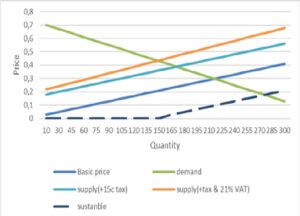
A tax of €0.15/kWh acts as an upward shift of the supply curve (dark to light blue line). Producers still receive their marginal cost price, but consumers pay an additional amount — the supply curve “shifts upward.” This results in a higher equilibrium price for consumers and a lower equilibrium quantity. If the quantity exceeds 300 by supply push from sustainable energy, the base price can become negative or sustainable energy must be curtailed. Including VAT (orange line) adds a percentage-based tax (21%) on top of the consumer price. Because it’s percentage-based, the shift behaves slightly differently. The top intersection (with the green demand line) shows the actual total price and quantity.
When large amounts of renewable energy such as solar and wind enter the system, the supply curve changes fundamentally. Unlike fossil power plants, which increase production at higher prices due to rising marginal costs, renewable sources always supply what is available — their marginal costs are nearly zero. As a result, the supply curve becomes almost vertical up to the level of available renewable production (till 150- price stays at zero, broken line; to find the demand you have to draw a vertical line from there to get the intersection with demand). Only beyond that point does the curve rise again due to the deployment of flexible sources like gas plants or storage. This explains why we sometimes see negative electricity prices: when supply is high and demand is low, producers (or consumers with dynamic contracts) must pay to get rid of the surplus. In fossil-based production, CO₂ emissions increase almost linearly with the deployment of power plants, following the so-called merit order: first the cheapest (mostly gas), then the more expensive ones (coal/ oil).
Impact of Taxes and Market Rules on Home Battery Business Cases
In current practice, you pay tax on electricity you purchase, but receive only the base market price (after meetering system/ saldering) when selling. This creates a price incentive that distorts the supply-demand structure and CO₂ optimization: you’re encouraged to buy cheap electricity or store your own generated energy, even when the market price is relatively high. From a system perspective, that energy should be sold, but it’s not profitable because later purchases — even at lower market prices — are more expensive due to taxes.
Therefore, people choose to store energy in their battery for later personal use. This observation is fundamental: it reveals how fiscal incentives and market rules negatively affect the CO₂ case for home batteries.
Self-consumption of solar energy is financially attractive for households: using battery-stored energy avoids high retail prices, while selling yields only a low market price. As a result, prosumers prefer to keep their energy, even when it would be socially better to feed it back into the grid. This leads to a loss of valuable flexibility in the energy system. The financial incentive shifts behavior away from CO₂ optimization: batteries are not used to flatten peaks or displace fossil power plants, but to minimize personal energy bills.
For example:
• 14:00: Solar power in that particular building is abundant, gas plants are still running, and the price is relatively high → CO₂-wise, it’s optimal to discharge the battery to the grid. But people in that building keep it stored.
• 20:00: The price is low due to wind energy, but taxes make it relatively expensive for consumers → stored energy is used instead. There is no consumption of the wind energy peak.
The fiscal and market model (without net metering, as planned) encourages self-consumption over system-wide CO₂ optimization.
Peer-to-Peer Energy Communities
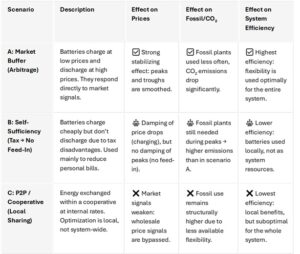
In peer-to-peer (P2P) energy exchanges within cooperatives, members trade energy among themselves, often bypassing the wholesale market. They use internal pricing or settlement systems, aiming for local self-sufficiency and tax benefits. As a result, batteries and flexibility are mainly used to supply fellow members, not the broader electricity system.
These systems respond less to market signals like peak prices or off-peak hours, undermining overall system efficiency. Fossil sources remain more necessary during peaks, and societal benefits — such as CO₂ reduction — fall short. While cooperatives help flatten prices at the bottom (e.g., charging during solar surplus), they contribute less at the top (limited market feed-in). This reinforces the earlier effect: a less efficient system with higher peaks and more fossil use than under optimal market conditions.
Remarks
• Under the net metering system (which is being phased out), the difference between purchase and sale is offset against taxes, largely eliminating the above effect.
• Batteries for grid congestion may change the business case.
• Social aspects for communities are important but can be organized differently.
• Different types of EMS (Energy Management Systems) handle buying and selling differently.
• This blog focuses only on the microeconomic approach in relation to CO₂. Other elements will be covered in future blogs.
Summary Table