

How Transfer Pricing Helps Build a Smarter, Fairer Energy Future – Reformers Example
As the energy system becomes more local, flexible and decentralized, new questions arise:
– How do we calculate the real cost of self-generated power?
– What is a fair price for stored energy?
– And how do we make sure different users in the system pay their share – no more, no less?
Within the Reformers project, we explore how local energy systems can benefit from transparent internal pricing models, using a method known as transfer pricing.
Understanding the Internal Rate of Return (IRR)
What is the Internal Rate of Return (IRR)?
The Internal Rate of Return (IRR) is the annualized return that an investment generates. It is the interest rate at which the Net Present Value (NPV) of all future cash flows (both incoming and outgoing) equals zero.
Why is this useful?
– To evaluate whether an investment is profitable (e.g., compared to borrowing costs).
– To calculate internal cost pricing (transfer pricing), especially for capital-intensive assets like batteries.
The Formula
The IRR is the value of ‘r’ that solves the equation:
0 = ∑(Cₜ / (1 + r)ᵗ) for t = 0 to n
Where:
– Cₜ = cash flow in year t (positive or negative)
– r = internal rate of return (what we’re solving for)
– n = project duration (in years)
Note: C₀ is usually negative (initial investment), and the other Cₜ values are positive (returns or savings).
Example
Imagine you invest €10,000 in a battery system that saves you €2,700 per year for 5 years. The equation becomes:
-10,000 + 2,700/(1 + r)^1 + 2,700/(1 + r)^2 + 2,700/(1 + r)^3 + 2,700/(1 + r)^4 + 2,700/(1 + r)^5 = 0
This equation can’t be solved easily by hand. You can use:
- Excel or Google Sheets: =IRR(range)
- Chat gpt
- A financial calculator
- Software (e.g., Python, R, financial planning tools)
Practical Use
In projects like Reformers, you might fix an internal rate (e.g., 6%). This means:
“We expect our investment to return at least 6% annually.”
This fixed IRR is used to:
– Calculate annual investment costs (e.g., annuity method)
– Derive internal cost prices per kWh
– Compare different investment options using a consistent benchmark
The Réformes project uses an innovative approach where we combine a neighborhood battery with a company’s battery. This offers the advantage of reduced infrastructure and grid connection costs because you work behind the meter, but it also presents several challenges, including how to calculate prices and governance. This blog discusses the financial aspects. The challenge is calculating the costs of the various devices and calculating the final price. So, you get a cost price for the solar panels on the company’s roof, a cost price for the battery, and because this is a fast-charging facility, you also need to factor in the cost of the charging platform for those charging stations. It’s assumed that the costs of housing and maintenance, carried out by the company, are also passed on to them. However, these are variable costs that we won’t consider here. It’s about the fixed costs that you must allocate and therefore be able to price. This is more common in the business world and is called transfer costing. It works as follows.
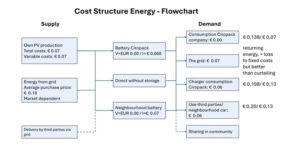
What’s happening in this system?
– Energy is supplied by two sources:
→ solar panels (with low production cost, e.g. €0.07/kWh)
→ or the national grid (at a higher average price, e.g. €0.18/kWh)
– Energy may be stored in:
→ a company-owned battery, or
→ a community (neighbourhood) battery
– Energy is then consumed by:
→ the main company (e.g. Ciropack)
→ company transport (EV charging)
→ local users or neighbours
→ or fed back into the grid
All numbers shown are fictitious and for illustration only – the goal is to demonstrate the principle.
Why transfer pricing?
In a setup like this, different internal users (e.g. the company vs. shared EV charging) need to be billed fairly for the energy they consume – especially when that energy has passed through storage.
That’s where transfer pricing comes in. It helps determine the internal cost price of electricity, by taking into account:
– generation cost,
– market price,
– battery investment,
– and internal capital costs (interest rate).
Example: Pricing stored energy via a community battery
Suppose:
– The community battery costs €50,000 to install,
– Has a lifespan of 10 years,
– And a fixed internal interest rate (or return requirement) of 6%,
– With 100,000 kWh flowing through the battery each year.
We can calculate the annualized cost of the battery using a simple annuity formula:
Annual cost ≈ €6,800/year
Spread over 100,000 kWh, this gives a storage cost of €0.068/kWh.
If the stored energy came from solar panels (€0.10), the total internal price for that energy becomes:
€0.10 (generation) + €0.068 (storage) = €0.168/kWh
This transfer price can now be used to bill internal departments, EV charging stations, or even neighbours who use the energy.
Additions:
- The cost price doesn’t have much to do with the sales price, although the market price can’t always be below the cost price, otherwise the project wouldn’t be profitable. However, if the PV system generates a lot of energy, it’s better to sell below cost price, i.e., €0.07. In the example, the PV system is sold, but not at a negative price (then you can disconnect it). This would result in a variable cost, which is €0.00 for PV panels. At least you’re making up some of the fixed costs. This classification is part of the Reformers report.
- The situation can change if grid congestion occurs and the grid operator provides compensation to mitigate it.
- Furthermore, the actual case examines the contribution of the HBE (Higher Energy Agency), which provides compensation in the context of mobility and is based on tradable emission regulations.
- This blog also does not take into account peer to peer communication between residents and the battery, which can lead to additional complications.
Why it matters
Using a structured transfer pricing model allows local energy systems to:
– allocate costs transparently,
– recover investments fairly,
– incentivize smart energy use (e.g. charging when solar is abundant),
– and ensure long-term financial sustainability.
By building in financial logic from the start, Reformers supports energy communities that are not just sustainable — but also economically resilient and socially fair.


