

An extra long blog.
- Introduction
The energy transition is not merely a technological challenge; it is also a profoundly social one. Shifting from fossil fuels to renewable energy involves not only installing batteries, heat pumps, and grid reinforcements, but also developing new forms of cooperation, trust, and collective decision-making. Energy projects therefore need to consider both technical feasibility and social engagement.
This blog discusses the REFORMERS project, an EU-funded initiative exploring innovative forms of citizen participation in sustainable energy. By comparing three contexts — an industrial park (Boekelermeer), an apartment complex (Overdie), and a large residential neighborhood (Plan Oost) — we illustrate how different participation models can be applied. We also reflect on action research as a methodology that bridges academic knowledge and practical change, offering a framework to understand participatory innovation in real-world settings.
Participation Models: A Short Overview
A wide variety of participatory models exist, each suited to different social and technical circumstances. Among the models used in REFORMERS are:
- World Café: An informal but structured method of small-group conversations where participants rotate between tables, generating creativity and collective insight. It is particularly suited for settings with a manageable number of stakeholders.
- Quadruple Helix model: A framework emphasizing cooperation between government, business, academia, and citizens. This model ensures that innovation is not purely technical but contributes to societal development.
- Citizens’ Assemblies: A deliberative-democratic model where participants are selected at random (often stratified to ensure diversity), providing fair representation across all social groups.
- AIDA marketing model: Originally from marketing, this approach describes how to generate participation through Attention, Interest, Desire, and Action. It is effective for recruitment, but does not automatically guarantee inclusivity.
- Rogers’ Diffusion of Innovations theory: A model describing how new ideas and technologies spread through society, beginning with innovators and early adopters before reaching a wider audience.
Case Comparisons
3.1 Industrial Park Boekelermeer
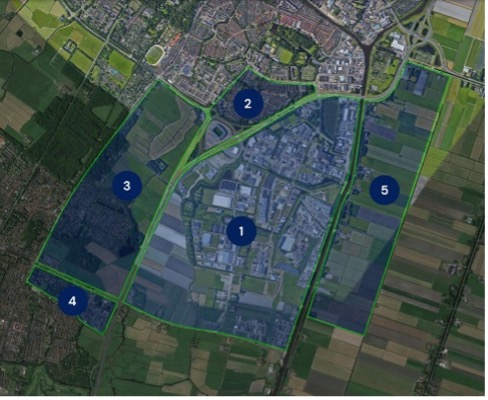
Industrial estates often involve a small number of influential actors. At Boekelermeer, the World Café method was used to allow business leaders, policymakers, and energy experts to exchange perspectives. Here, the Quadruple Helix is key: the involvement of government, academia, business, and civil society ensures that outcomes are not limited to technical solutions but also address broader issues such as employment, sustainability, and social cohesion. At the same time, it is important to recognize that:
- The primary drivers of transformation are the businesses themselves. Companies are the ones that make investment decisions, implement new technologies, and ultimately carry the financial risk of the transition.
- The role of government, by contrast, is not to substitute for private initiative but to anticipate, facilitate, and support these business-led investments. Public authorities provide the regulatory framework and long-term vision for the region. This includes setting sustainability targets, ensuring social inclusion, and articulating a shared regional strategy that gives direction to private initiatives.
Thus, in the Quadruple Helix model, each actor has a distinct but interdependent role: business as the engine of investment and innovation, government as the provider of vision and enabling conditions, academia as the source of knowledge and evaluation, and civil society as the anchor of legitimacy and inclusion. Only by balancing these roles can the energy transition contribute not only to decarbonization but also to sustainable regional development. If it concerns the quadruple helix, here lies the key to success.
3.2 Overdie Apartments
In high-rise apartment blocks, residents have limited freedom of choice because of central infrastructure upgrades. Participation therefore focuses on information provision: residents are informed about decisions, asked for consent, and offered space for dialogue, but their individual options remain constrained. Importantly, expectations must be managed: when investment is low, residents should not be led to believe that broad influence is possible.
3.3 Plan Oost
With more than 1,100 homes — including 76 % owner-occupied dwellings — Plan Oost represents a heterogeneous context where each household can invest in its own solution (e.g., home batteries). Collective methods like World Cafés are less effective here, as attendance at general meetings is typically low and only with people who are very interested in the subject with the result that others are excluded.
3.3.1 Citizens’ Assembly
A Citizens’ Assembly would be ideal to ensure inclusivity. By using random selection, all social groups — including lower-income households — could be represented. In the Reformers project, a Citizens’ Assembly could have played an important role in Plan Oost by actively involving residents in the energy transition.
- A representative group of citizens is selected to deliberate on local energy challenges and opportunities.
- Participants receive clear and balanced information from experts, municipalities, and project partners.
- Through structured dialogue, they discuss trade-offs, voice concerns, and co-create possible solutions.
Benefits:
- Builds trust and legitimacy in decision-making.
- Reduces resistance by addressing doubts and fears openly.
- Strengthens community ownership of sustainability measures such as home batteries and neighborhood energy sharing.
By embedding a Citizens’ Assembly in Plan Oost, Reformers fosters social acceptance, turning the energy transition from a top-down policy into a collective, shared project.
As a spin off the goal can is to produce recommendations for policymakers that are legitimate, inclusive, and informed which is useful when political systems need more public legitimacy, trust, and participation in complex decision-making processes. However, without municipal support, this was not feasible in Heiloo. Instead, the project shifted toward a marketing-based approach (AIDA) combined with Action Research.
3.3.2 AIDA (Attention, Interest, Desire, Action)
AIDA is a classic marketing and communication model, primarily developed for sales and advertising campaigns. Its purpose is to guide customers step by step toward a purchase or another desired action.
Explanation
- Attention – The first step is to capture the audience’s attention (for example, with a striking advertisement or strong opening).
- Interest – Next, interest is generated by presenting advantages or relevant information.
- Desire – Then, desire is created by showing how the product or service meets specific needs or solves problems.
- Action – Finally, the audience is prompted to act: to buy, register, click, or get in touch.
Because AIDA is strongly sales-driven, it is somewhat limited for broader communication or societal projects. In such contexts, the focus is not always on “selling,” but rather on raising awareness, fostering engagement, and supporting behavioral change.
AIDA works well to recruit participants. However, as shown in Heiloo, this does not necessarily lead to a representative cross-section of the neighborhood, and may even increase social inequality. To build awareness and sustained engagement, residents were invited to sign contracts committing to participation in meetings and interviews, ensuring continuity and learning over time. This was implemented through action research.
3.3.4. Action Research: Method and Relevance
Action Research is central to the REFORMERS approach at Plan Oost. It is characterized by a cyclical process of planning, action, observation, and reflection. The method combines academic research with practical intervention, making it particularly suited for contexts where social innovation and technological experimentation go hand in hand.Key characteristics include:
- Collaboration: Researchers and participants work together as co-creators of knowledge. This role can be oicket up by university InHolland
- Commitment: Participants sign agreements to remain engaged throughout the project, ensuring continuity.
- Cyclicality: Insights from each cycle feed back into the next, allowing adaptation and learning.
- Dual Outcomes: The method produces both practical improvements (e.g., optimized battery use) and academic insights (e.g., lessons on citizen engagement).
Action research is an important methodology because it bridges theory and practice. It demonstrates that research can not only describe reality but also actively transform it. In the energy transition, this is essential: technical solutions cannot succeed without social embedding, and action research provides the tools to achieve this. For Plan Oost de planning for the process is made till 2028.
3.3.5 Diffusion of Innovations in Plan Oost
The energy transition in Plan Oost can be understood through Rogers’ Diffusion of Innovations model, which explains how new ideas and technologies spread within a community. The model distinguishes different groups:
- Innovators – the first to experiment with technologies such as home batteries.
- Early Adopters – respected community members who inspire others by showing positive results.
- Early Majority & Late Majority – larger groups who follow once benefits become visible and risks seem manageable.
- Laggards – those who adopt only at the very end, if at all.
In Plan Oost, early installations and pilot users act as frontrunners, creating visibility and experience. As more neighbors join, the process moves toward the tipping point—the moment where adoption accelerates and becomes self-sustaining.
Once this tipping point is reached, the effort and investment required from government and project partners to promote sustainability decreases significantly. The innovation begins to reinforce itself through social learning, peer influence, and visible success stories—provided the technology works reliably and delivers clear benefits. This shows that the Reformers project is not just about installing batteries, but about creating the conditions for a self-strengthening process of local energy transition.
- Conclusion
The REFORMERS project illustrates the diversity of participation models in the energy transition. Industrial estates benefit from deliberative methods like the World Café, apartment blocks require strong information provision, and heterogeneous neighborhoods like Plan Oost demand inclusive methods such as citizens’ assemblies or, where not possible, a combination of marketing and action research. The diffusion model of Rogers finishes the job. If the groundwork is done well the process of diffusion will do the work; if frustration is build up the energy transition will be blocked. model of
This case underscores the value of linking theory to practice, and of using action research as a methodological bridge. Blindly applying tools without understanding the models can cause a lot of damage to the process. The energy transition is both a technological and a social project — and only by understanding both dimensions can we hope to make it succeed.


